The short answer
Groundwater and storm water are treated as contaminated, which changes material decisions, and a finished basement hides the wet assembly behind drywall and flooring until readings or a selective opening find it.
Basement water removal
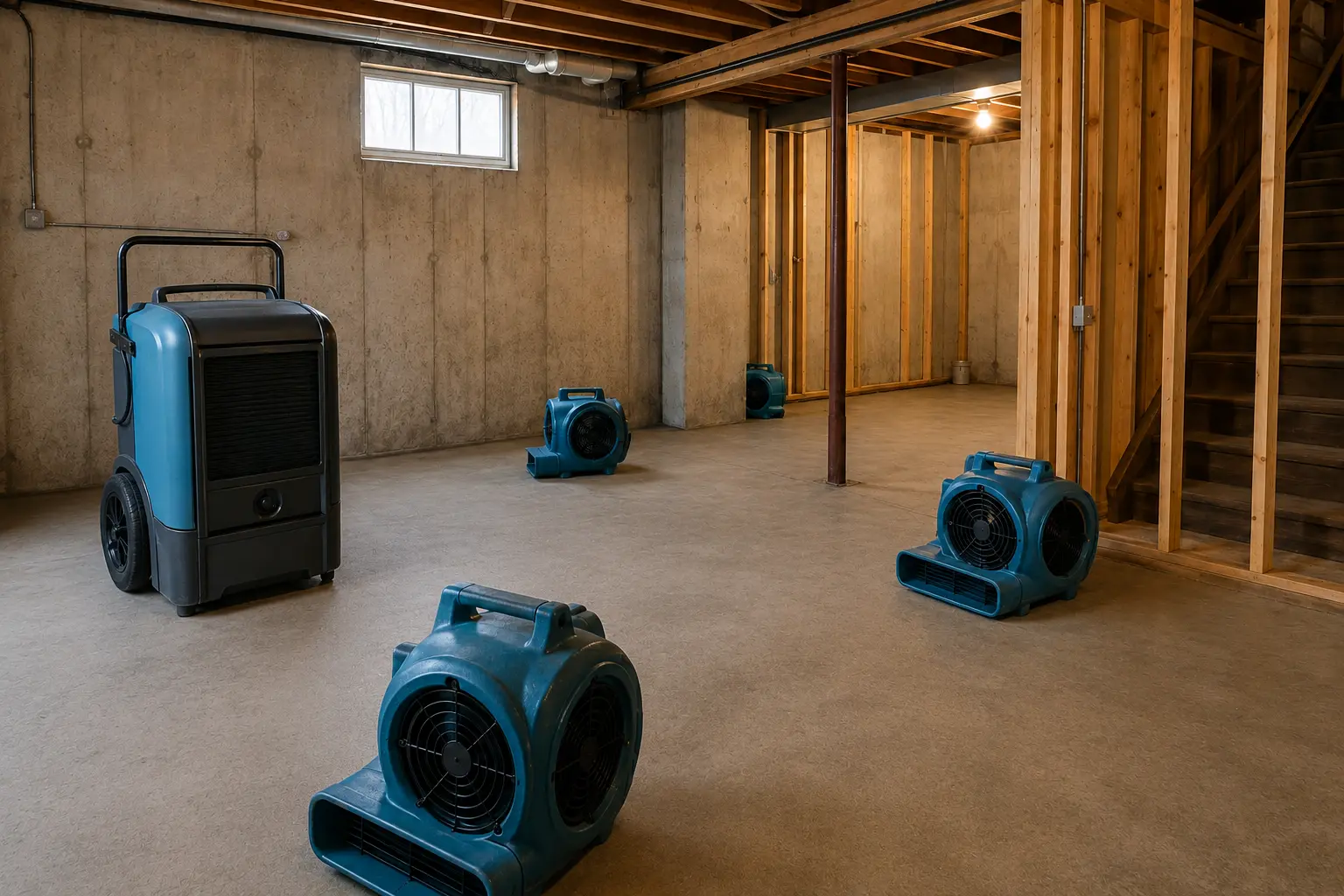
Standing water is extracted first so the drying process can begin. The restoration team then checks finished walls, baseboards, flooring, sill areas, storage and adjoining rooms for moisture that is not obvious from the surface.
- Water extraction and pump-out
- Wet carpet and pad removal
- Drywall and insulation evaluation
- Moisture readings in floors and walls
- Air movers and dehumidification
- Cleaning and odor treatment
- Repair and reconstruction planning
Common causes of basement flooding
Basements flood from burst pipes, failed water heaters, sump pump problems, drain backups, heavy rain, foundation seepage and outside floodwater. The source affects both cleanup and prevention. Plumbing, drainage, waterproofing, septic or municipal sewer work may be needed alongside restoration.
Start the restoration request
Need restoration service for this property?
Send the address, callback number and a short description of the damage. You do not need to diagnose the problem before requesting help.
Finished and unfinished basements
Finished basements often hold water inside wall cavities, flooring layers and insulation. Unfinished basements can still have wet framing, stored contents and mechanical systems. The restoration plan should follow measured moisture rather than assume unfinished materials will dry on their own.
Water can travel behind baseboard, inside insulated stud walls, under floating floors and into stored contents beyond the visible water line. The inspection should account for those layers before a pump-out is declared complete.
Selective access and material readings can support a focused removal plan. Sewage, outside floodwater or deteriorated material may require broader removal and cleaning.
The long-term source may need another contractor
A plumber handles failed piping and sump components. Drainage, grading, foundation or waterproofing specialists address recurring groundwater and site conditions. Restoration handles the current wet building.
Ask for those responsibilities in writing so drying equipment is not left running against an uncontrolled recurring source.
What actually drives the cost
Stored contents are frequently the larger loss. Cardboard, textiles and paper on a slab absorb immediately and are usually the first thing written off.
- Source: plumbing, groundwater, storm water or sewer
- Whether the basement is finished or unfinished
- Depth of water and how long it stood
- Volume and type of stored contents
- Whether the slab or foundation is feeding moisture continuously
- Whether mechanical systems in the basement were affected
What is included, and what is a separate scope
The scope covers extraction, removal of affected porous materials, cleaning appropriate to the water source, drying the slab and wall bases, and readings that confirm it.
Correcting why water arrived is separate and is usually drainage work: grading, gutters and downspout discharge, a sump and its discharge line, or exterior drainage. A basement that takes water more than once is a drainage project, not a repeated cleaning project.
The Greater Burlington basement pattern
The regional cycle runs a wet spring from snowmelt over still-frozen ground, which cannot absorb it, into a humid summer that loads cool masonry from the air. Properties in the lower parts of Winooski, Colchester and Essex Junction see high water tables; hillside properties in Richmond, Jericho and Underhill see concentrated surface flow.
Older fieldstone and rubble foundations, common across the region's pre-war stock, are more permeable than poured concrete and generally need exterior grading and drainage addressed instead of interior coatings.
Why basements flood across this region
The cause changes with the geography. In the upland and rural towns, Hinesburg, Jericho, Underhill, Westford, Essex, Charlotte, it is usually surface water during the March and April melt, because frozen ground cannot absorb it and it finds foundations, window wells and bulkheads. In the developed centre it is more often a sump failure, a supply line or a backup.
River-corridor property in Winooski, Richmond, Milton, Fairfax and parts of Colchester faces the third pattern: melt combined with rain raising a river. Those three causes look identical once the water is on the floor and are handled very differently by an insurance policy, which is why establishing where the water came from is the first question rather than an afterthought.
Where the water came from changes everything
Basement water from four different sources produces four different scopes. Establishing the source is the first thing that happens, not a detail.
| Source | Contamination | Typical material outcome | Usual correction |
|---|---|---|---|
| Supply line or appliance | Sanitary | Much dried in place | Plumbing repair |
| Groundwater through slab or wall | Contaminated | Porous materials removed | Exterior drainage and grading |
| Storm or surface water | Contaminated | Porous materials removed | Grading, discharge, sometimes a sump |
| Sewer or drain backup | Grossly contaminated | Porous materials removed, containment used | Drain repair or backwater valve |
Step by step
How a flooded basement is cleaned up
The order matters more here than anywhere, because the water source decides the whole scope.
Establish where the water came from
A supply failure, a sump failure, melt water through the foundation and a river event look identical once on the floor and are handled, and insured, very differently.Make the space safe
Power to the affected area is treated as live until cleared. Submerged furnaces, water heaters and panels are not restarted to see whether they work.Extract and remove
Standing water is extracted, then padding, soaked insulation and any porous material that contacted contaminated water is removed.Handle contents
Stored contents are separated, recorded and moved to dry ground. Basements are where households store what is irreplaceable, so this is done before drying, not after.Dry the structure and the slab
Concrete absorbs water and releases it slowly, so slab readings, not room feel, determine when flooring can go back down.Correct what let the water in
Grading, gutters, downspout discharge, window wells and sump arrangement are the recurrence problem. Drying alone guarantees a repeat.
Clear answers
Common questions
How is water removed from a flooded basement?
The method depends on depth, source and contamination. Restoration professionals may use extraction equipment or pumps, then remove damaged materials and install drying equipment.
Can basement carpet be saved?
Clean-water carpet may sometimes be restored when addressed quickly. Carpet exposed to sewage, outside floodwater or long saturation often requires removal.
Why does my basement flood every spring but not in summer?
Frozen ground cannot absorb snowmelt, so it becomes surface runoff and follows grade to the lowest point. The ground's ability to accept water is the variable, not the rainfall.
My sump pump was working. Why did it still flood?
Most commonly the discharge line was frozen, blocked or discharging too close to the foundation. A working pump with a blocked outlet moves nothing.
Can stored belongings be saved?
Non-porous items generally clean up. Cardboard, paper, textiles and anything upholstered that sat in contaminated water is usually removed. Photograph everything before it moves.
Should I finish the basement again the same way?
In a basement that has taken water more than once, materials that tolerate wetting and a design that keeps the wall base accessible make the next event much cheaper.
Is interior sealant a fix?
Not for groundwater under pressure. Water appearing at the wall-floor joint or through the slab generally needs exterior grading and drainage work.