The short answer
Residue type follows what burned, and that determines the cleaning method, which is why fire scopes are set by inspection instead of by area.
Emergency services come first
Do not enter an active or unreleased fire scene. Call 911 for active fire, smoke, gas, electrical or structural hazards. The restoration process begins only after the responsible authority permits access.
Residues require material-specific cleaning
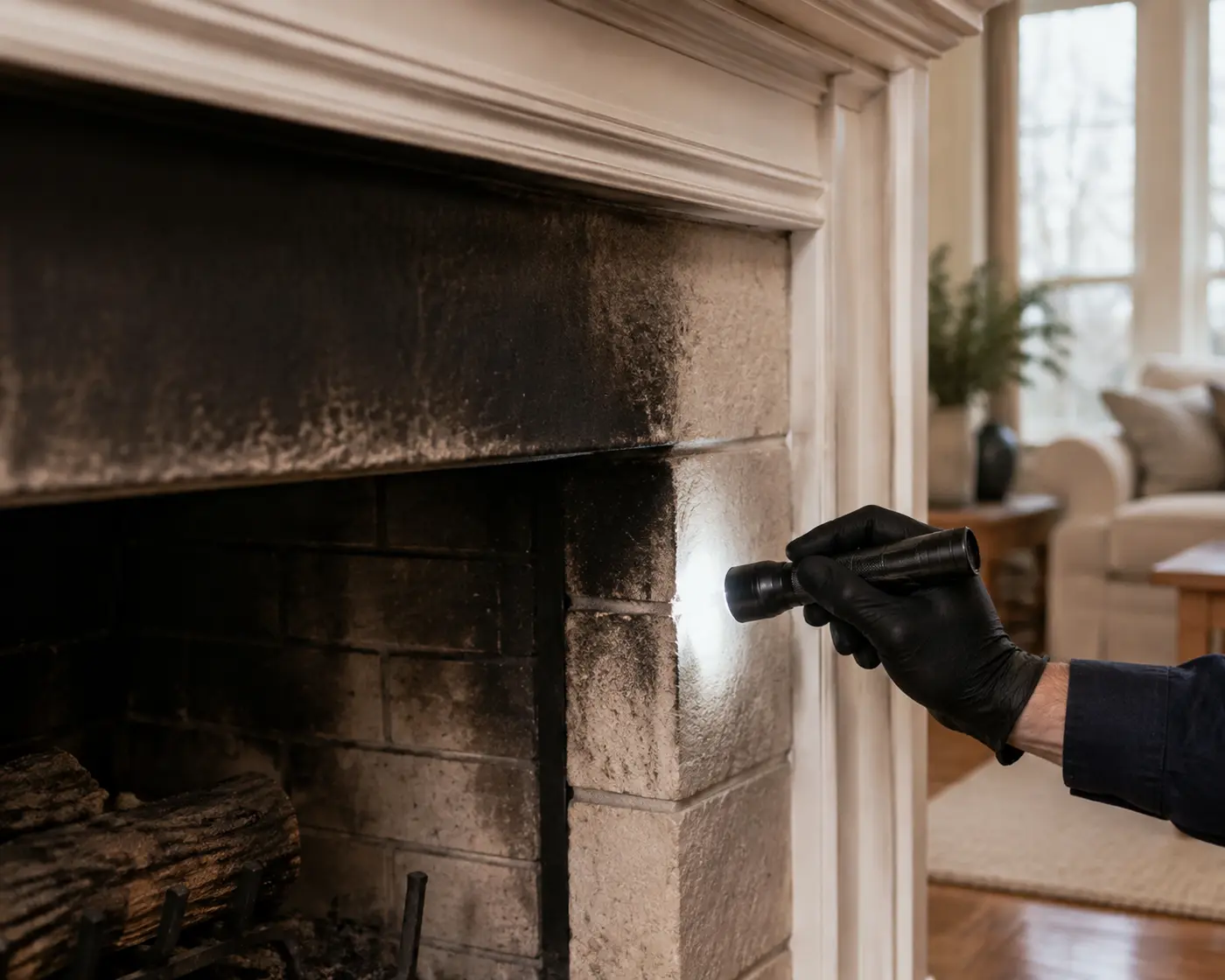
Soot and smoke residues vary with what burned and how heat moved through the building. Incorrect wiping or household cleaning can spread or set residues. A qualified provider should test methods, protect unaffected areas and explain which surfaces or contents are restorable.
Dry soot, oily residue and protein-related fire residue respond differently to cleaning. Painted surfaces, unfinished wood, metal, glass, electronics and textiles may require separate testing and methods.
Odor treatment follows source removal and cleaning. Fogging, hydroxyl, ozone or sealing should not be used to mask residue that remains on building surfaces or contents.
Start the restoration request
Need restoration service for this property?
Send the address, callback number and a short description of the damage. You do not need to diagnose the problem before requesting help.
Water and contents are separate parts of the loss
Firefighting water can create an immediate drying need even when flame damage is limited. Contents may be inventoried, packed out, cleaned, stored or declared nonrestorable. Ask who controls the contents process and how decisions will be documented.
Fire restoration includes the water used to fight the fire
Firefighting water can affect floors, ceilings, wall cavities and contents beyond the burned area. Stabilization and water removal may start before soot cleaning, odor work and reconstruction are fully scoped.
The company should distinguish structural evaluation, board-up, water mitigation, residue cleaning, contents and repairs so each phase is understandable.
What actually drives the cost
Fire losses are priced across three separable problems that arrive together: what burned, what the smoke reached, and what the water used to put it out did. The third is frequently the largest by area, and it is the one owners least expect.
Residue type matters more than most people assume.
- Area directly damaged by fire and heat
- How far smoke and residue travelled through the building
- Water and suppression damage through the structure
- Contents volume and whether specialty cleaning is needed
- Odour work, which is a separate process from surface cleaning
What is included, and what is a separate scope
The scope commonly covers emergency board-up and stabilisation, water removal from suppression, residue cleaning by surface and residue type, odour treatment and contents handling.
Structural assessment, electrical assessment where heat or water reached wiring, and full reconstruction are separate. On a significant fire the municipality may also have an inspection role before reoccupancy, and that is not a decision a restoration contractor makes alone.
Fire work in Greater Burlington's building stock
In the region's older duplexes, converted multi-unit buildings and mixed-use blocks, smoke does not respect unit boundaries. Balloon-framed cavities, shared chases and common stairwells carry residue into spaces that never saw flame, which is why the inspection boundary is set by the building rather than by the room.
Where the building predates 1978, cleaning and demolition of painted surfaces bring lead-safe requirements into the work, and older materials may raise asbestos questions. Both belong in the first scoping conversation.
Fire and smoke in this region's buildings
Two things about the local stock change fire work here. Balloon framing in the oldest Burlington, Winooski and Richmond housing lets smoke travel uninterrupted inside wall cavities from the sill to the attic, so residue reaches places that have no connection to the fire. Dense multifamily and mixed-use buildings in Winooski, downtown Burlington and Essex Junction mean a single incident affects units and tenancies that were never near it.
Heating is the other local factor. Woodstoves, chimneys and oil-fired furnaces are common across this region, and each produces a different residue: wood smoke, a chimney fire, and the oily soot of a furnace puffback all need different cleaning approaches, and using the wrong one drives the residue permanently into surfaces.
Residue type decides the cleaning method
Using the wrong method sets or smears residue and turns a cleanable surface into one needing replacement.
| Residue | Typical source | Character | Cleaning consideration |
|---|---|---|---|
| Dry smoke | Fast-burning wood and paper | Powdery, lighter | Dry methods first; moisture can set it |
| Wet smoke | Slow, smouldering, plastics | Sticky, smeary, strong odour | Needs solvent-based approach |
| Protein residue | Cooking and food | Near-invisible film, very strong odour | Easily missed; odour drives the scope |
| Fuel oil soot | Furnace puffback | Fine and oily | Smears badly when dry-wiped |
Step by step
How fire and smoke restoration proceeds
Three overlapping problems: what burned, what the smoke reached, and the water used to put it out.
Confirm the building is safe to enter
Structural, electrical and utility clearance comes first, and it is not a judgement to make from the doorway.Secure the envelope
Board-up and temporary cover stop weather, heat loss and further loss. In a Vermont winter an open building freezes within hours.Address the firefighting water
The water is treated as a water loss in its own right, with extraction and structural drying, and it frequently affects more area than the fire did.Identify the residue types
Dry soot, oily puffback residue, protein residue and wood smoke each need a different cleaning method. Using the wrong one drives the residue permanently into the surface.Clean structure and contents by method
Surfaces are cleaned to the residue type, contents are assessed and handled separately, and HVAC is addressed because a system that ran has distributed residue everywhere it serves.Deodorise at source, then seal what remains
Odour work follows residue removal. Where cleaning cannot fully remove it, sealing before repainting is what stops it coming back through the new finish.Rebuild
Reconstruction follows verified drying and completed cleaning, with pre-1978 lead requirements settled before demolition rather than during it.
Clear answers
Common questions
Can I clean soot myself?
Avoid aggressive wiping or household cleaners before the residue and surface are assessed. Some residues smear, corrode or require specialized methods, and the building may have other hazards.
Who removes smoke odor?
A fire-restoration provider should identify and remove residue sources before selecting odor-control methods. Fragrance alone is not restoration.
Why is there so much water damage after a fire?
Suppression water travels far beyond the fire itself and frequently affects more square footage than the flames did. It is a standard part of a fire loss and is dried like any other water damage.
Can smoke odour really be removed?
Odour work addresses porous materials holding residue and the building's air path, not just surfaces. Treatment that masks odour without addressing those materials tends not to hold, particularly once heating comes back on.
Which belongings can be saved?
It depends on residue type and material. Hard non-porous items clean well; porous textiles, upholstery and paper are harder and sometimes documented as non-restorable. Inventory before anything moves.
When can we move back in?
Fire adds structural, electrical and air-quality questions, and the municipality may have a role. It is not a decision a restoration contractor makes alone.
Authoritative references