The short answer
Equipment stays until readings reach the goal, not for a preset number of days.
A drying plan should be measured
The provider should establish where moisture is present, select reference points, place equipment for the actual assembly and return to document progress. Equipment count alone does not prove the plan is appropriate.
Dry in place or remove
Clean, structurally sound materials may sometimes be dried in place. Removal may be needed for contamination, loss of integrity, vapor barriers that block drying, inaccessible insulation or finishes that cannot be restored economically. Ask why each material is being removed.
Start the restoration request
Need restoration service for this property?
Send the address, callback number and a short description of the damage. You do not need to diagnose the problem before requesting help.
Drying ends at a defensible goal
There is no universal number of days for every building. Completion should be based on material readings, comparison with unaffected areas and the restoration plan, not simply when equipment has run for a preset period.
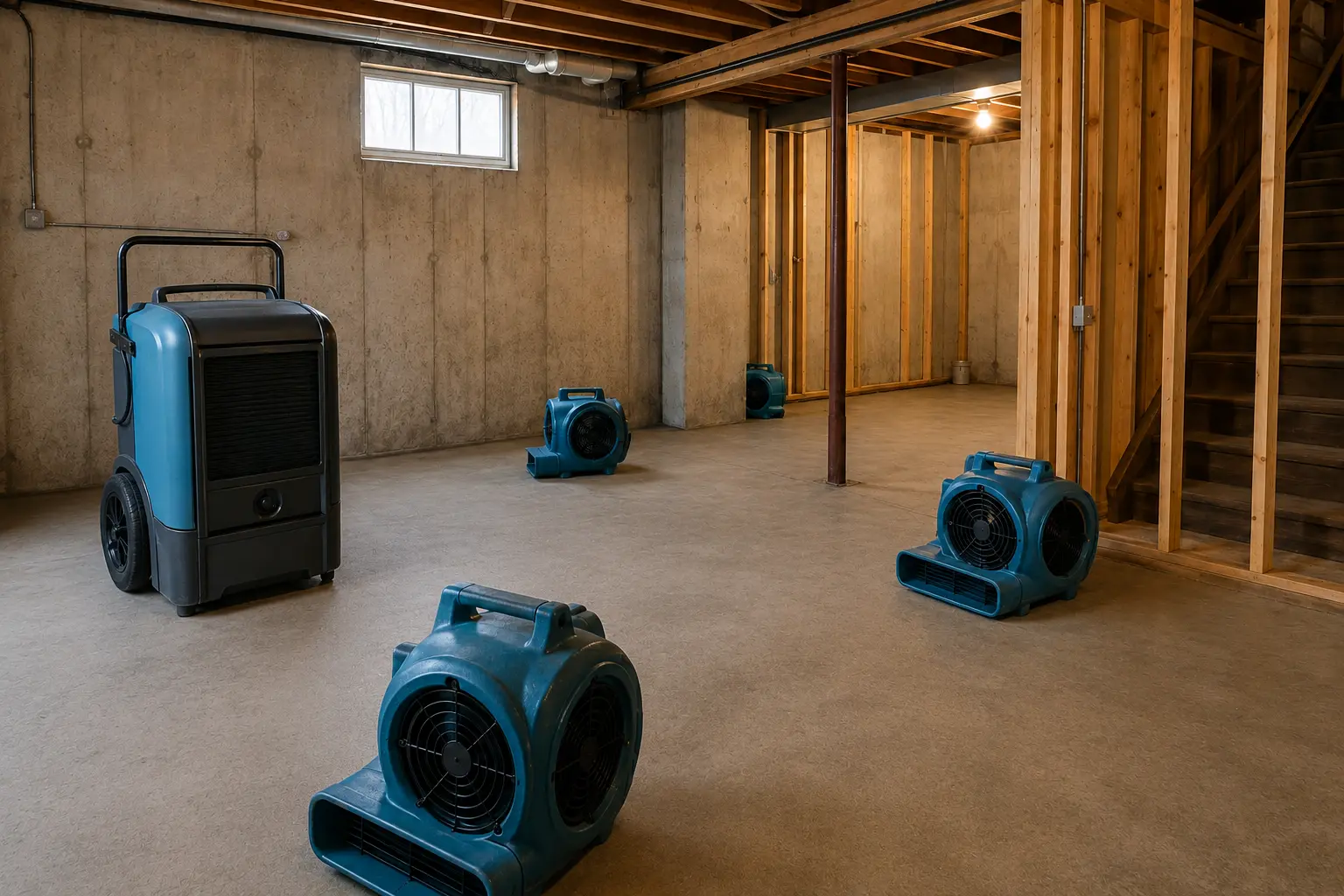
Air movers and dehumidifiers do different jobs
Dehumidification removes that moisture from the air. Temperature, containment and material exposure affect how the two processes work together.
More machines are not automatically better. Placement, equipment capacity, power availability and recorded conditions are what make the setup defensible.
Drying completion should be documented
The company should identify the meter and material locations used to track progress and compare them consistently. Unaffected material can provide a useful local reference because different wood, concrete and finish systems do not share one universal number.
Before reconstruction, ask for the completion note or final readings that support closing the wall, floor or ceiling assembly.
What actually drives the cost
Drying is billed by equipment unit per day, so the number of days the readings support is the cost. Denser materials, concealed cavities and cold weather all extend that, and none of them is negotiable: the material dries when it dries.
The way to reduce drying cost is not fewer days. It is starting sooner and providing access, both of which shorten the time the equipment has to run.
- Material mass and permeability: plaster and concrete are slow
- Whether the assembly can be opened for access
- Ambient temperature, which is a real factor in a Vermont winter
- Number of separate areas needing their own equipment
- Whether specialist in-place systems are needed for a floor
- How quickly drying started after the loss
What is included, and what is a separate scope
Structural drying covers equipment placement, daily monitoring visits, readings against a dry reference area, repositioning as areas reach the goal, and the record that shows it happened. The monitoring visits are the technical core of the job, not an add-on.
It does not include reinstating anything that was removed. If the drying goal is met and the room still has no baseboard, that is the reconstruction scope, and it should already have been estimated while drying was running.
Winter drying takes longer here
Cold outdoor air holds less moisture, which changes what ventilation can achieve and puts more of the work on dehumidification. The same loss in a Greater Burlington property in January will commonly run longer than it would in September.
In older buildings with plaster, layered flooring and closed cavities, expect the mid-week investigation step to matter more, because those assemblies conceal more than modern construction and readings are the only way to see inside them.
Drying times across this region's materials
Drying schedules here are set by what the building is made of, and this region's range is unusually wide. Plaster over lath in Burlington's Hill Section, board sheathing in an old Richmond village house, masonry and heavy timber in a converted Winooski mill and a concrete slab in a Williston warehouse all hold considerably more water than drywall over studs and release it far more slowly.
That is why a schedule copied from a national average misses here. Drying finishes when meter readings on the actual affected materials reach the documented target, and in the region's older and denser assemblies that regularly runs longer than the three-to-five days a straightforward modern loss takes.
What the equipment is actually doing
Air movers and dehumidifiers do different jobs and are counted separately on an invoice. Knowing which does what makes the equipment line legible.
| Equipment | What it does | Why the count varies |
|---|---|---|
| Air mover | Moves air across wet material so moisture leaves it | Scales with affected surface area |
| Dehumidifier | Removes the moisture from the air | Scales with the volume of the space |
| Desiccant unit | Removes moisture at low temperature or high volume | Used in cold or large spaces |
| In-place floor system | Pulls air through a floor assembly | Only where a floor is being saved |
| Air scrubber | Filters particulate within the work area | Used with containment |
Step by step
How structural drying is planned and verified
Drying is a measured process with a documented endpoint, not a fixed number of days.
Establish dry standard
Unaffected material of the same type in the same building is read first, to set the target the wet material has to reach. Without it there is nothing to dry to.Map affected materials
Each affected material is read and recorded by location, because plaster, hardwood, subfloor, masonry and concrete all release water at different rates.Size the equipment to the space
Air movers and dehumidification are set to the affected volume, the class of loss and the materials, and containment is used to keep the treated air where it is needed.Control the environment, not just the surfaces
Temperature and humidity are managed so evaporation can actually happen. Equipment running in an uncontrolled space moves air without removing much water.Re-read on every visit and record it
The same points are re-read each visit and logged. A stalled reading means a reservoir nothing has opened up yet, not that the material is finished.Confirm and release
Drying is complete when the affected materials reach the dry standard, and the record of that is what reconstruction proceeds on.
Clear answers
Common questions
How long does structural drying take?
It varies with materials, saturation, temperature, humidity, access and contamination. A provider should explain the monitoring plan instead of guaranteeing a duration before inspection.
Why are moisture readings important?
They help identify hidden spread, guide equipment and document progress. Readings should be interpreted in context because different materials and meters behave differently.
What is a drying goal?
The documented moisture level the affected material has to reach, set by reference to an unaffected area of the same material in the same building. It is what makes 'dry' a measurement rather than an opinion.
How many days should drying take?
It depends on material, access and temperature, and it ends on readings instead of a schedule. What you should expect is daily monitoring and a record showing the readings moving toward the goal.
Is the noise and heat normal?
Yes. The equipment runs continuously and raises the temperature in the work area. Turning it off to sleep extends the project and adds equipment days.
What happens if a material is not drying?
That usually means moisture is trapped behind a finish or the assembly cannot be reached. The response is more access or removal, and it should be explained and documented when it happens.
Authoritative references