The short answer
A complete restoration scope uses all three and ends drying based on measured conditions instead of a preset number of days.
Inspect and establish boundaries
The provider identifies the source, water type, affected materials and spread. Initial readings create a map for decisions and later comparison.
Extract before relying on evaporation
Removing liquid water is generally more efficient than asking drying equipment to evaporate it. Porous finishes, cavities and contents may require different extraction or removal methods.
Start the restoration request
Need restoration service for this property?
Send the address, callback number and a short description of the damage. You do not need to diagnose the problem before requesting help.
Balance airflow and dehumidification
Air movement supports evaporation; dehumidification removes moisture from the air. Temperature, containment and equipment placement are adjusted to the structure and conditions.
Document progress and completion
Ask for affected-area notes, equipment records, material readings and the basis for completion. Reconstruction should not conceal unresolved moisture.
Extraction reduces the amount equipment must remove
Pumps, weighted extraction tools and wet-recovery equipment remove water that would otherwise have to evaporate. The method depends on water depth, flooring, access and contamination. Extraction should include secondary areas where water migrated, not only the center of the visible room.
After liquid water is removed, the provider identifies materials that can dry in place and materials that block drying or cannot be restored. This decision sets the equipment and demolition scope.
Drying equipment controls the environment
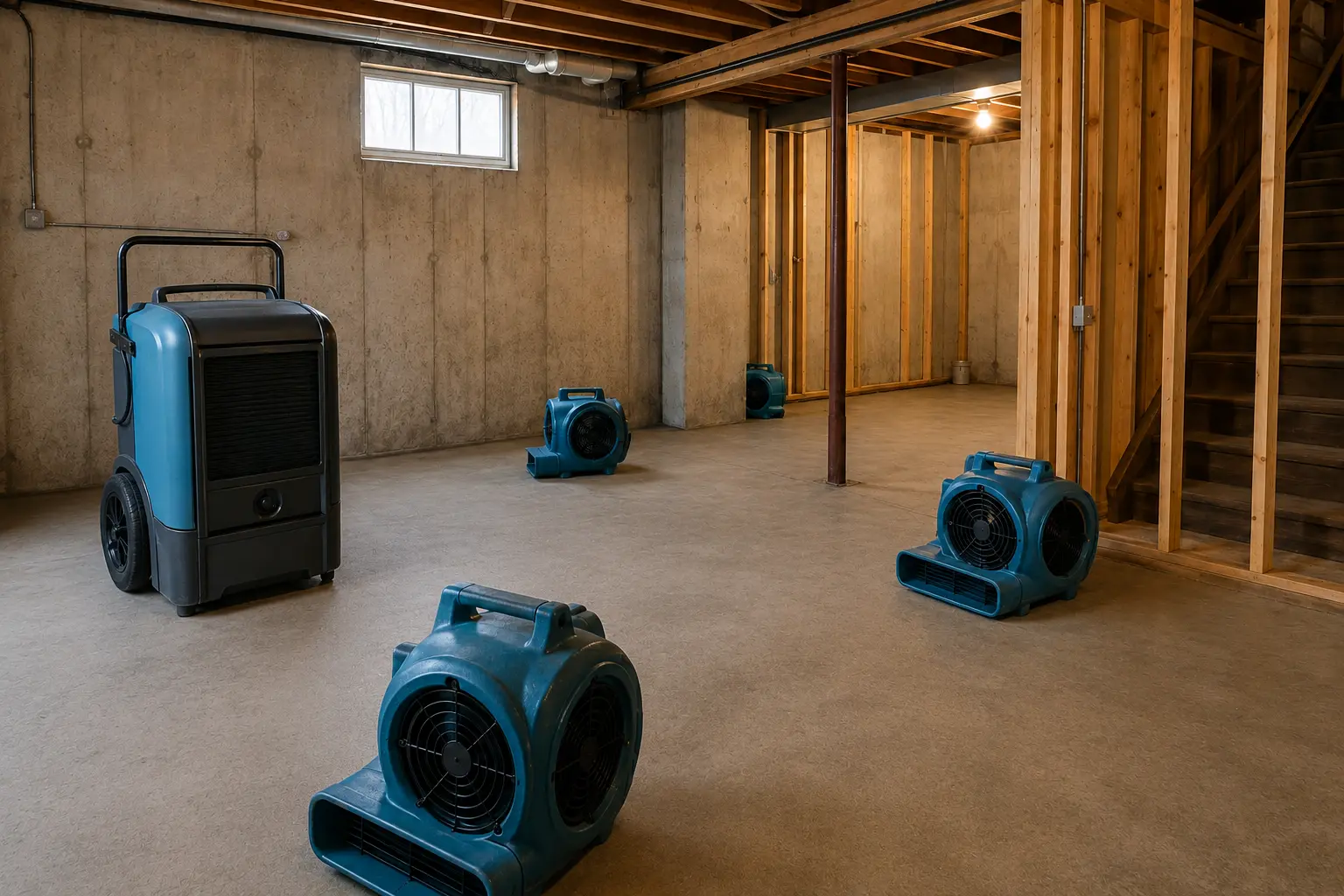
Air movers increase evaporation at wet surfaces. Dehumidifiers remove water vapor from the air. Temperature and containment affect both processes. Equipment should be placed for the actual wall, floor or cavity rather than distributed evenly for appearance.
Open windows, disconnected equipment or uncontrolled HVAC changes can undermine the plan. Ask what equipment may be moved or switched off and how often the restoration team will check performance.
Monitoring turns drying into evidence
Daily or scheduled visits should record atmospheric conditions, material readings, equipment operation and changes to the plan. Readings need location labels so progress can be compared over time. A single unexplained meter number is not useful documentation.
Completion should reflect the material, unaffected comparison areas and the project goal. Before reconstruction, request the final readings or completion note that supports closing the affected assembly.
Drying buildings through Vermont seasons
Outdoor air in Greater Burlington can be cold and dry in winter, warm and humid in summer or wet during a prolonged storm. Professional drying is based on controlled indoor conditions and material readings instead of assuming that opening windows will help.
Older plaster, dense wood, insulated exterior walls and layered flooring may dry differently from modern drywall assemblies. Comparison readings should come from relevant dry materials in the same building whenever possible.
Extraction, drying and monitoring compared
Each one answers a different question and has its own evidence.
| Stage | What it does | What proves it worked |
|---|---|---|
| Extraction | Removes liquid water | Standing water gone, less load on equipment |
| Structural drying | Moves moisture out of materials using airflow and dehumidification | Falling moisture readings day over day |
| Monitoring | Records conditions and adjusts equipment | Daily logs that show the trend |
| Completion | Ends drying based on measurement | Readings at or near the dry standard, not a preset number of days |
Clear answers
Common questions
Why are moisture readings taken more than once?
Repeat readings show whether specific materials are drying, whether the affected boundary changed and whether equipment should be moved, added or removed.
What determines how long drying equipment stays?
Material type, saturation, assembly access, temperature, humidity and measured progress matter. Equipment removal should follow the documented drying goal instead of an automatic number of days.
Why is the equipment running for days?
Because materials release water slowly. Air movers keep evaporating moisture off surfaces and dehumidifiers remove it from the air; turning them off early leaves water in the assembly where nothing can see it.
Can I turn the fans off at night?
No. Drying stops when the equipment stops, and moisture redistributes back through the materials overnight. If noise is a genuine problem, raise it. Placement can sometimes change, the running time cannot.
How do I know when it is actually dry?
By meter readings on the affected materials matching a documented target, recorded on each monitoring visit. Ask to see those readings; a verbal assurance that it feels dry is not verification.
Authoritative references