The short answer
Floodwater is treated as grossly contaminated, so porous materials it contacted are generally removed instead of dried, and the building is cleaned before it is dried, regardless of how clear the water actually looked while it was standing in the basement. Confirm the structure and utilities are safe before entering, document everything before removal, and check state and federal recovery guidance because flood damage is usually outside a standard homeowners policy and needs its own separate claim path entirely.
Safety before property
Structural movement, undermined foundations and displaced utilities are all possible after flooding. Electrical systems that were submerged need an electrician's assessment before power is restored, and that is not a judgement call for a property owner.
Private wells and septic systems that were inundated raise their own questions, which the Vermont Department of Health addresses directly.
Why floodwater changes the material decisions
Floodwater passes over ground, roads, agricultural land and sewer infrastructure before it reaches a building.
That is the main reason flood restoration costs more per affected square foot than an equivalent clean-water loss.
Start the restoration request
Need restoration service for this property?
Send the address, callback number and a short description of the damage. You do not need to diagnose the problem before requesting help.
Clean first, then dry
The sequence matters. Drying a contaminated surface locks the contamination into a now-dry material, and the odour and residue remain.
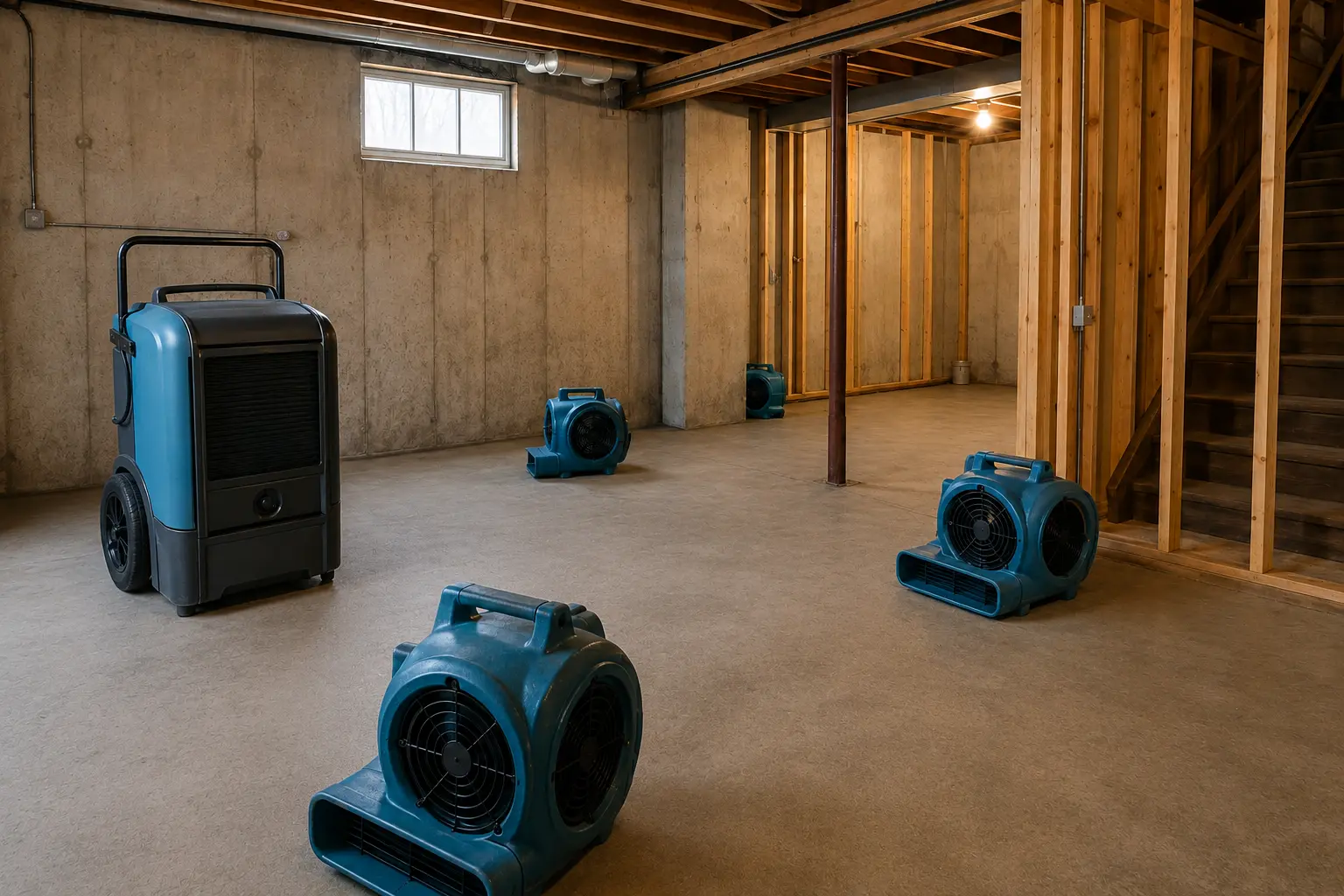
Cleaning the structure before drying equipment goes in is the standard order, and a scope that reverses it is worth questioning.
Documentation that matters for recovery programmes
Federal and state assistance, where available after a declared event, works from documentation the property owner creates in the first days.
- Photographs of every room before anything is removed
- The high-water line, clearly visible
- Exterior photographs showing the water's extent
- An inventory of removed and discarded contents
- Receipts for pumping, cleaning and emergency work
- Dates throughout, and the source of the water
Insurance and the flood distinction
A standard homeowners policy generally does not cover damage from surface flooding. That is a separate flood policy, and the distinction is not about how the water behaved indoors but where it came from.
If a property took both a plumbing failure and floodwater in the same period, document them as separate events from the beginning.
The rebuild question in a flood-prone location
Where a building has flooded before, rebuilding exactly as it was reproduces the exposure. Elevating mechanical systems, choosing materials that tolerate wetting and rethinking what is stored below the water line are decisions worth making at the rebuild instead of after the next event.
Local floodplain requirements may also apply to substantial reconstruction, which is a municipal question.
Where Greater Burlington is exposed
The Winooski River corridor, low-lying parts of Winooski and Colchester, and properties near Lake Champlain carry the region's most direct flood exposure, and Vermont's Climate Assessment documents increasing heavy-precipitation trends for the state instead of decreasing ones.
Municipal procedures differ from town to town across Vermont, and rural properties on private wells and septic systems have recovery steps that town-sewered properties do not. Confirm your own municipality's process rather than assuming Burlington's applies.
Flood recovery order
Floodwater is treated as grossly contaminated, so the order of work differs from an ordinary leak, with the structure and utilities confirmed safe first, porous materials the water touched generally removed instead of dried and the building cleaned before it is dried, and the table gives that sequence with the reason for each step.
| Step | What happens | Why in this order |
|---|---|---|
| Safety | Confirm structure and utilities are safe | Hazards come before property |
| Remove contaminated materials | Porous materials the water touched are generally removed | Cannot be reliably cleaned |
| Clean | Clean the building surfaces | Drying contamination in place fixes it there |
| Dry | Structural drying with monitoring | Only after cleaning |
| Document | Photos and records for recovery programs and insurance | Needed for claims and assistance |
Step by step
Recovering a Vermont property after flooding
The sequence for a building that has taken floodwater, from confirming it is safe to enter through to drying and reinstatement.
Confirm it is safe to enter
Check for structural movement, and do not restore power to a building where water reached wiring, panels or appliances until an electrician has assessed it.Document before you touch anything
Photograph every room, the high-water line, contents and the exterior before removing a single item. This record supports every later decision and claim.Remove standing water and mud
Pump or extract remaining water and remove silt while it is still wet. Dried silt is far harder to deal with and carries whatever the water carried.Remove contaminated porous materials
Carpet, pad, fibrous insulation, particleboard and affected drywall below the water line are generally removed instead of dried, because floodwater is treated as grossly contaminated.Clean before drying
Clean the remaining structure. Drying a contaminated surface fixes the moisture and leaves the contamination in place.Dry to a documented goal
Run drying equipment with readings against a dry reference area. Vermont masonry and framing hold moisture for a long time and surfaces mislead.Reinstate only once dry
Rebuild after the structure meets its drying goal, not when the schedule would prefer. Closing up early puts the problem behind new material.
Clear answers
Common questions
Can I restore power once the water is out?
Not until an electrician has assessed any system, panel or appliance that was submerged. That is not a property owner judgement.
How long until a flooded building can be reoccupied?
After the structure is dried and verified, contamination is addressed and the utilities and mechanical systems have been checked by the relevant trades. It is a sequence of confirmations, not a fixed number of days.
What order should the work happen in?
Safety and utilities first, then removal of contaminated and unsalvageable material, then cleaning, then drying and verification, then rebuild. Rebuilding before verification is the expensive mistake.
Authoritative references