The short answer
Growth can begin within roughly 24 to 48 hours on wet organic materials under ordinary indoor conditions, but the range is wide and depends on temperature, material and how wet it stayed. The practical takeaway is not the number: it is that drying speed is the variable you control, so extraction and drying should start as soon as it is safe.
What the number means and does not mean
It is not a deadline after which a property is written off, and it is not a promise that nothing happens before it.
Treat it as a reason to start drying immediately rather than as a measurement of your particular building.
What moves the range
Temperature matters: a cold basement in March behaves differently from a heated bathroom. Material matters: paper facing and dust-laden surfaces support growth more readily than clean non-porous material. Saturation and airflow matter, because a surface that dries in hours does not stay wet long enough.
A concealed cavity with no airflow is the worst case, which is why concealed water is treated more urgently than an equal amount on a tile floor.
Start the restoration request
Need restoration service for this property?
Send the address, callback number and a short description of the damage. You do not need to diagnose the problem before requesting help.
Why speed is the actionable part
You cannot change the material a wall is made of after a leak, and you cannot change the season. You can change how fast the water leaves.
That is why extraction, controlled removal and drying equipment begin as early as it is safe, and why the drying record matters later if there is a claim.
The first day, practically
What is done in the first hours has more effect on the outcome than anything decided later in the project.
- Stop the water at the source or the shutoff
- Remove standing water where it is safe to do so
- Photograph everything before material is moved
- Lift and separate wet contents from wet floors
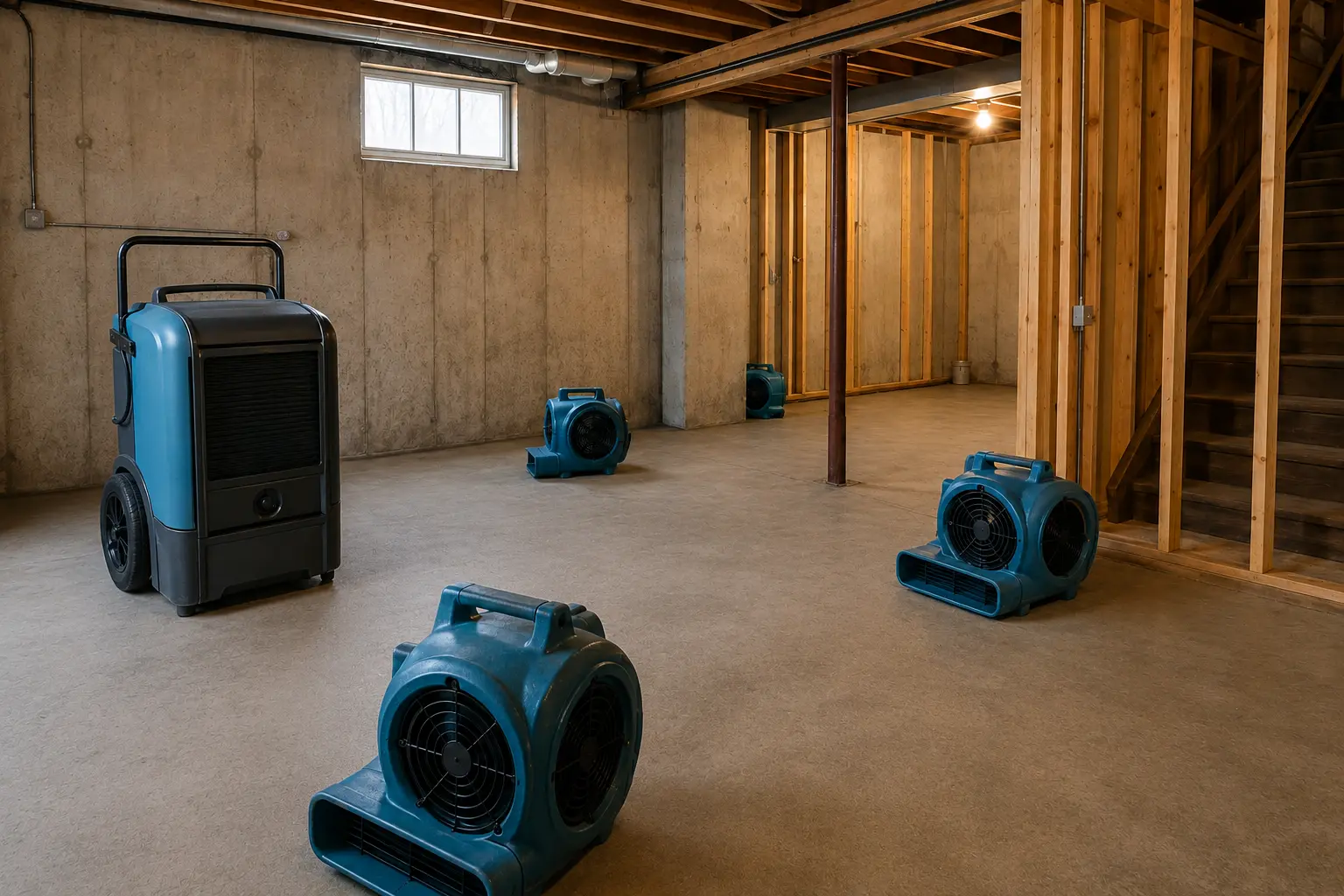
- Get air moving and, where appropriate, dehumidification running
- Arrange professional assessment for anything concealed
If you are past the window
Discovering water days or weeks later changes the assessment, not the value of acting. More material is likely affected, more will be removed and inspection matters more.
It does not mean growth is established everywhere, and it does not mean the building is unsalvageable. It means the inspection needs to be thorough.
Records that matter later
Discovery time, photographs before disturbance, the mitigation start time and the daily drying readings are the record that supports both the repair decisions and any claim.
Gaps in that record are where disputes start.
Vermont seasons pull the range in both directions
A January pipe failure in an unheated Vermont space can leave materials wet and cold, slowing growth but also slowing drying, so the exposure is longer. A July basement loss meets warm humid air that supports growth and makes dehumidification harder.
The same volume of water at the same address behaves differently in February and August, which is one reason preset drying schedules are a poor substitute for readings.
What changes how fast growth starts
| Variable | Faster growth | Slower growth |
|---|---|---|
| Material | Organic, porous | Non-porous |
| Wetness | Stays wet | Dried quickly |
| Temperature | Warm | Cold |
| Air movement | Still, humid air | Moving, dry air |
Clear answers
Common questions
If I dried it within a day, am I safe?
Prompt drying substantially reduces the risk, but concealed materials may still be wet. Verification is by readings in the material, not by how the surface feels.
Does drying quickly prevent mold entirely?
It removes the condition growth needs, which is the whole basis of emergency response. It is why hours matter and why a fast, complete dry-down is worth more than anything applied afterwards.
Does cold weather stop mold growing?
It slows it. A cold crawl space or basement can hold a problem in check through winter and produce visible growth when it warms, which is why spring reveals what winter hid.
Authoritative references