The short answer
Basement mold usually comes from one of two sources: liquid water entering through walls, slab or a failed sump, or humid air condensing on cool surfaces in summer. The correction differs completely. Removing growth without identifying which one you have is why it returns within a season.
Water entry or condensation
Water entry leaves evidence: staining at the base of walls, efflorescence on masonry, damp patches after rain, a sump that runs constantly. Condensation is a summer pattern: surfaces feel damp when the outside air is warm and humid, and the problem eases in winter.
The two need opposite responses. Water entry calls for drainage, grading and sometimes a sump. Condensation calls for controlling the humid air, which usually means dehumidification and not more ventilation with outside air.
Why summer ventilation often makes it worse
Opening basement windows in July feels like the obvious fix and frequently is not. Warm humid air entering a cool basement raises the moisture load on cold surfaces instead of lowering it.
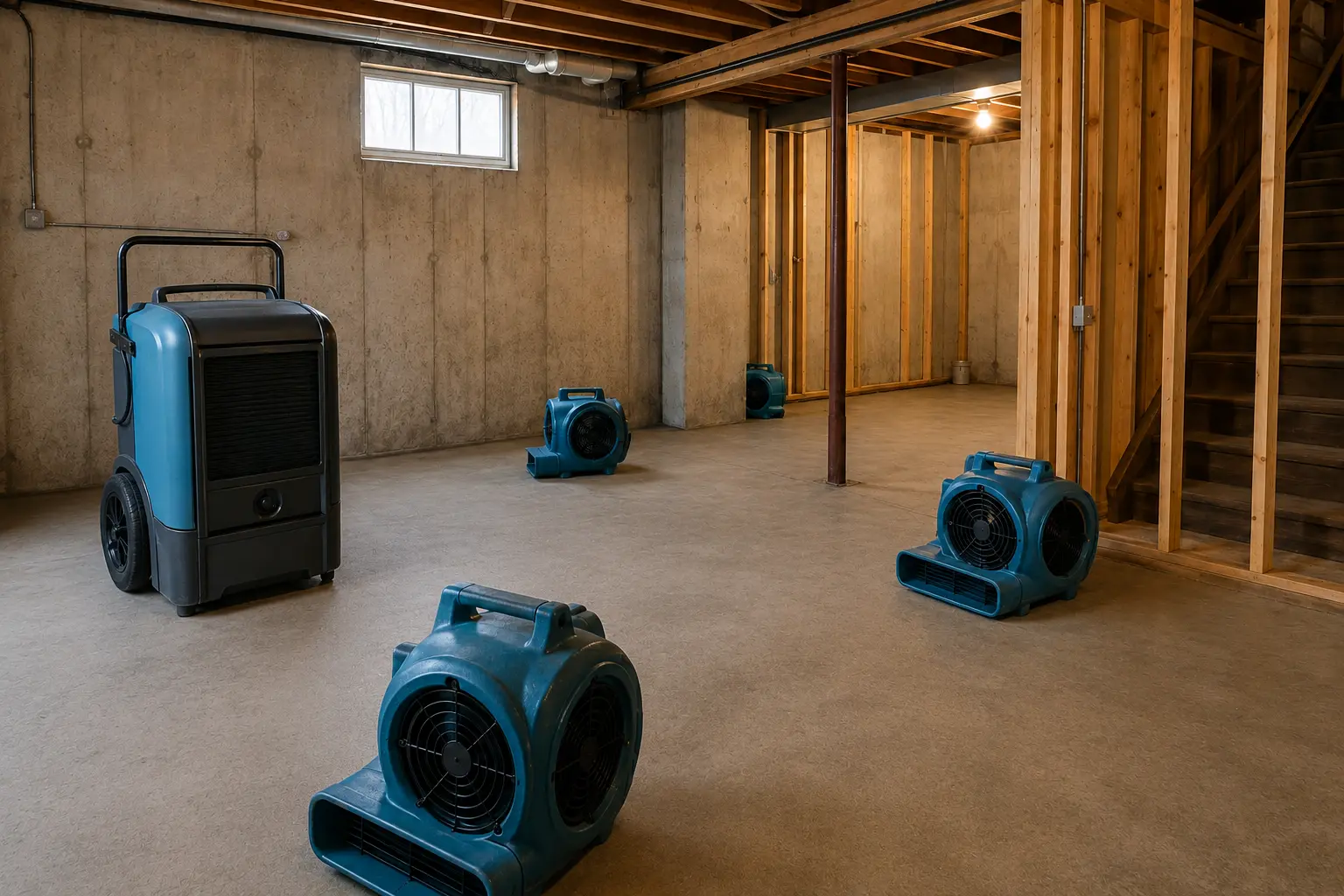
A dehumidifier sized for the space, with a drain, run through the humid months, is usually a better tool than airflow from outside.
Start the restoration request
Need restoration service for this property?
Send the address, callback number and a short description of the damage. You do not need to diagnose the problem before requesting help.
What is actually affected
In many basements the growth is on stored goods and on organic finishes rather than on the masonry itself. Cardboard, paper, fabric, untreated wood and the paper facing on drywall are the food sources; concrete is not.
That changes the scope. Sometimes the largest part of the job is decisions about contents, not the building.
Finished basements complicate everything
A finished basement puts drywall, framing, insulation and flooring between you and the assembly that is wet. Growth may be established on the back of the finish long before anything is visible on the room side.
Investigation usually means selective openings at the base of walls. That is not damage, it is the only way to see what is happening.
Correct in this order
The sequence matters more than the products. Stop liquid water, then control humidity, then deal with affected materials, then reinstate finishes.
- Correct grading, gutters and downspout discharge outside
- Confirm the sump and its discharge line work
- Control interior humidity through the warm months
- Remove or clean affected materials to a written scope
- Reinstate finishes only once materials meet the drying goal
Storage practice keeps it away
Once corrected, how the space is used determines whether it stays clear. Cardboard on a slab, textiles in contact with masonry and stacked paper are the usual re-offenders.
Shelving off the floor, plastic bins instead of cardboard and a gap between stored goods and exterior walls remove most of the food source.
Chittenden County basements and the seasonal cycle
The regional pattern is a wet spring from snowmelt and rain, followed by a humid summer that loads cool basement surfaces. Homes near Lake Champlain and in the lower parts of Winooski, Colchester and Essex see both, sometimes in the same year.
Older fieldstone and rubble foundations common in the region are more permeable than poured concrete and need exterior drainage and grading addressed instead of interior coatings alone.
Basement mold: water or condensation
| Feature | Water entry | Condensation |
|---|---|---|
| Where it appears | Along walls, floor joints, near cracks | On cool surfaces, cold pipes, stored items |
| When it worsens | After rain and thaw | In humid summer weather |
| Correction | Drainage, grading, sump, crack repair | Dehumidification and moisture control |
| Airing out | No help | Often makes it worse in summer |
Clear answers
Common questions
Why does my basement smell musty without visible mold?
Odour commonly comes from growth on the back of finishes, on stored goods or inside a cavity. Odour is a reason to investigate, and it is not itself a measurement of anything.
Does concrete grow mold?
Concrete is not a food source. Growth on masonry is generally on dust, residue or organic material on the surface, which is why cleaning plus moisture control works there.
Do I need to remove finished basement walls?
Only what the scope establishes as affected. Selective openings at the wall base are usually how the extent gets determined.
Is a dehumidifier enough for a Vermont basement?
It manages humidity, which helps, but it does not correct water entering through the foundation or a grade sloping toward the building. Running one permanently usually means something upstream has not been fixed.
What humidity should a basement sit at?
Generally kept below the range where growth is supported, which in practice means monitoring instead of guessing. A cheap hygrometer left in the space tells you more than any single reading.
Authoritative references