The short answer
Concrete absorbs and holds substantial moisture and releases it slowly, so slab drying is measured in weeks instead of days. The slab itself is rarely damaged, but flooring, adhesives and anything installed over it will fail if it goes down too soon. Drying is confirmed by an appropriate concrete moisture test, not by surface feel.
What water does to concrete
Concrete is porous and holds water within its structure. It is not usually damaged by a water event, and the structural question rarely arises.
The problem is entirely about what happens next: adhesives that fail, flooring that lifts, and moisture emerging through the surface for months.
Why it is slow
Moisture leaves a slab by diffusion, which is far slower than evaporation from a wood surface. A slab that felt dry within days can continue releasing moisture for weeks.
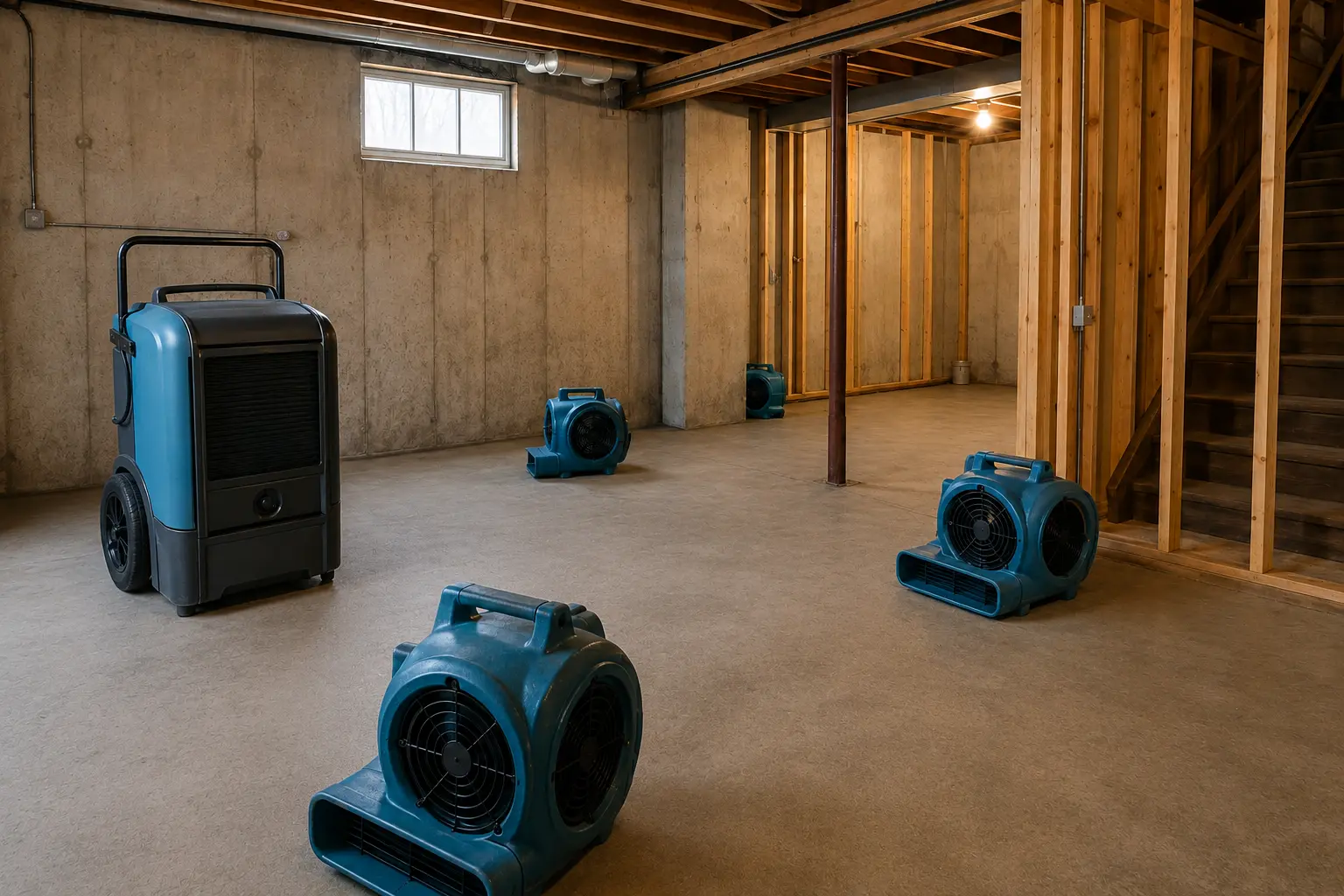
Drying can be accelerated with dehumidification and airflow, and it still takes considerably longer than the wood assemblies around it.
Start the restoration request
Need restoration service for this property?
Send the address, callback number and a short description of the damage. You do not need to diagnose the problem before requesting help.
Measuring it properly
Concrete moisture is assessed with tests designed for it rather than with a pin meter intended for wood. Flooring manufacturers specify what their products require, and those requirements are the operative standard.
Surface feel is not a measurement, and a slab that appears dry can still be well above what a floor covering will tolerate.
The failure that follows early installation
Every one of these traces back to flooring going down over a slab that had not reached the required level.
- Adhesive failure and lifting at edges
- Bubbling or blistering under sheet materials
- Efflorescence appearing through the surface
- Odour beneath an impermeable floor covering
- Wood flooring cupping over a slab
- Warranty claims declined for excess substrate moisture
Vapour from below
A slab poured without a vapour barrier beneath, or over a high water table, can take up moisture from the ground continuously. That slab never reaches a low moisture level, whatever drying is applied.
Where that is the situation, the answer is a moisture-tolerant floor covering or a barrier system, not more drying time.
Planning around it
Where a slab is involved, the drying phase is likely to gate the whole project. Knowing that at the start allows other work to be sequenced around it instead of everyone waiting.
It is also the moment to decide whether the floor covering that failed is the right one for that slab.
Vermont basement slabs and the water table
Many Greater Burlington basement slabs, particularly in the older housing stock and in the valley towns with high water tables, were poured without an effective vapour barrier beneath. Those slabs take up ground moisture continuously and will not reach a low reading regardless of drying effort.
For those floors, the practical answer after a water event is a moisture-tolerant covering instead of an impermeable one, plus seasonal dehumidification. Installing a sealed floor covering over a slab that is fed from below reproduces the failure on a schedule.
Slab drying: what to know
Concrete dries in weeks, not days.
| Topic | What to know | Implication |
|---|---|---|
| Absorption | Concrete holds substantial moisture | Slow release |
| Measurement | Use an appropriate concrete moisture test | Not surface appearance |
| Flooring | Fails if installed too early | Wait for verified readings |
| Vapour from below | Can keep rising | Plan around it |
Clear answers
Common questions
Is the slab itself damaged?
Usually not. The structural question rarely arises. The problem is what gets installed over it before it has dried.
How long does a concrete slab take to dry?
Considerably longer than framing and drywall: concrete absorbs water and releases it slowly, and readings on the slab instead of the room are what determine when flooring can go back.
Can flooring be installed over a slab that is still drying?
No, and doing it is a reliable way to produce adhesive failure, cupping or growth under the new floor. Slab moisture is measured before flooring, not assumed.
Authoritative references