The short answer
Shoreline properties near Lake Champlain face three separate moisture problems: high-water events reaching structures, spring ice action against shoreline works and foundations, and persistent seasonal humidity in crawl spaces and basements. They need different responses and are frequently confused with one another.
High-water events
Lake levels vary seasonally and in response to sustained rain and snowmelt across the basin. Where levels reach a structure, the water is surface water and is treated as contaminated in the same way as any flooding.
That means porous materials in contact with it are generally removed instead of dried, and the structure is cleaned before it is dried.
Ice action in spring
Ice moving with wind and level change exerts substantial force on shoreline structures, retaining works and anything at the water's edge. Damage there is a structural and shoreline question instead of a restoration one.
Where ice movement has displaced or cracked a foundation element, that assessment comes before any interior work is planned.
Start the restoration request
Need restoration service for this property?
Send the address, callback number and a short description of the damage. You do not need to diagnose the problem before requesting help.
The humidity that never leaves
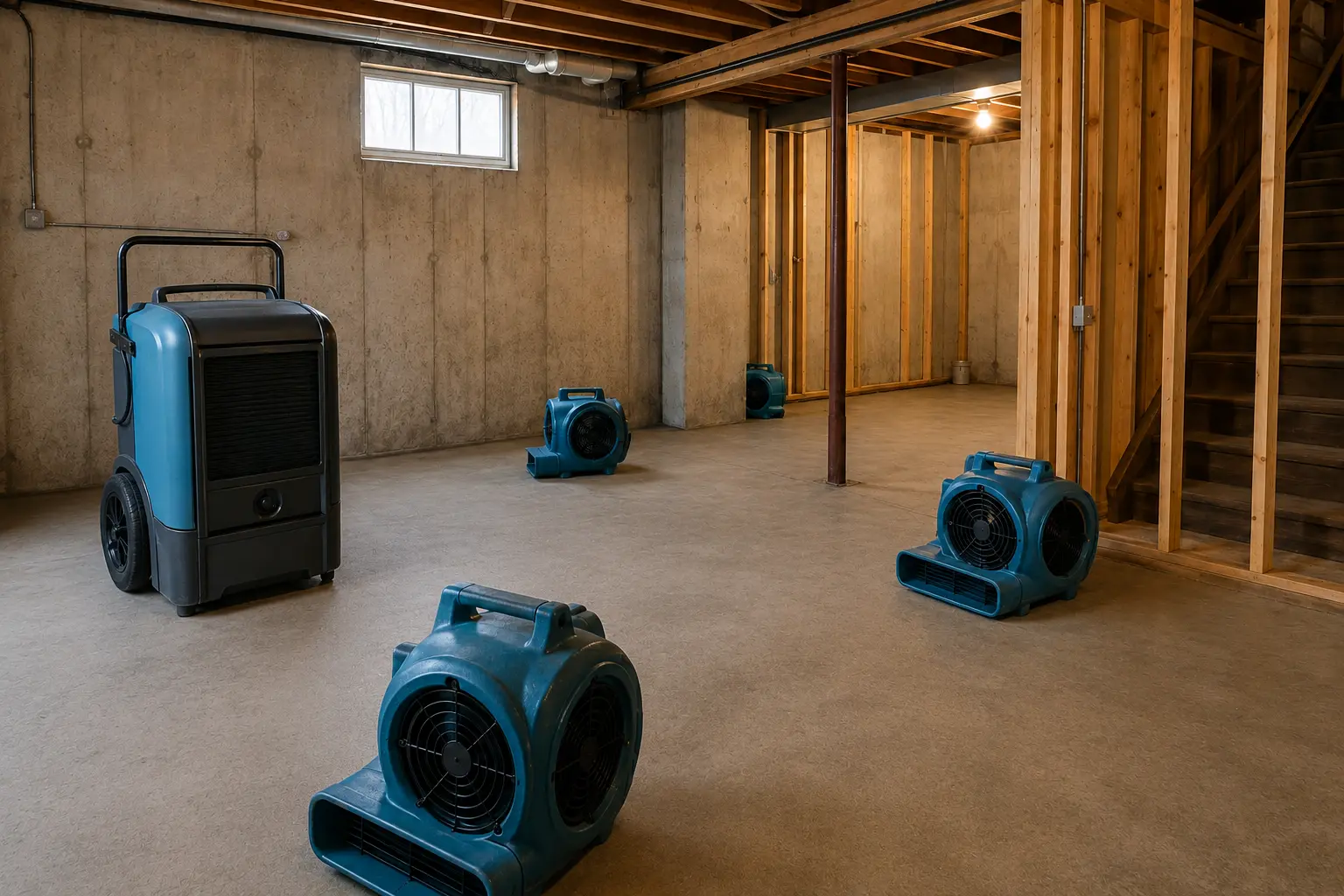
Shoreline buildings frequently have crawl spaces and basements that stay damp through the warm months regardless of any event, because humid air over cool ground and masonry condenses continuously.
That is a maintenance problem addressed with ground vapour barriers and dehumidification, and it is the most common source of odour and growth in these buildings.
What to address in order
The three problems have different owners and different timescales, and mixing them produces work that does not hold.
- Structural and shoreline damage assessed first
- High-water contamination handled as a flood loss
- Ground vapour barrier installed in any crawl space
- Seasonal dehumidification for the humid months
- Mechanical systems raised above known high-water levels
- Materials at the water line chosen to tolerate wetting
Seasonal occupancy compounds it
Many shoreline properties are seasonal, so both the freeze risk of a closed building and the summer humidity problem apply to the same structure at different times of year.
A camp closed from October needs draining for the freeze; the same building needs moisture control from June. Both belong in the annual routine.
Rebuilding in a flood-exposed location
Substantial reconstruction in a floodplain can carry municipal requirements, and rebuilding exactly as before reproduces the exposure. Elevating systems and choosing tolerant materials is the point at which the next event becomes cheaper.
Confirm requirements with the municipality before designing the rebuild, not after.
Shoreline towns in the service area
Colchester, Burlington, South Burlington, Shelburne and Charlotte all carry Lake Champlain frontage within the service area, with a mix of year-round homes and seasonal camps, and Milton and the Franklin County towns sit on the inland waters and river corridors feeding the lake.
Vermont's Climate Assessment documents trends toward more intense precipitation for the state, which bears directly on basin-wide runoff and lake levels. Municipal floodplain administration differs by town, so the applicable requirements are a local question rather than a regional one.
Three shoreline moisture problems
| Problem | What it is | Typical response |
|---|---|---|
| High-water events | Lake level reaching structures | Flood-contamination cleanup and drying |
| Ice action | Spring ice pushing on shoreline works and foundations | Inspection for structural and foundation effects |
| Persistent humidity | Damp crawl spaces and basements year after year | Humidity and ground moisture control |
Clear answers
Common questions
Why does lakeside property stay humid later in the year?
The lake holds warmth into autumn and moderates nearby air temperature, so the humid part of the year runs later than it does inland. Basements and crawl spaces there stay in a favourable range for growth longer.
Does ice damage shoreline structures?
Ice movement and shove can affect shoreline structures and anything close to the water line. Damage there is assessed separately from the building interior and often involves different trades.
Authoritative references