The short answer
Class describes the evaporation load: how much material is wet, how absorbent it is and how hard it will be to dry, and it decides how much drying capacity the space needs and roughly how long it will take.
Category: what is in the water
Category two carries significant contamination and can cause discomfort or illness. A dishwasher discharge, a washing machine overflow, water that has stood. Category three is grossly contaminated: sewage, flood water from outside, water carrying harmful agents.
The category decides what can be dried and kept versus what has to be removed, and it can escalate. Category one water left standing in a warm building degrades over time and gets reclassified upward, which is why response speed changes what survives.
Class: how much of the building is wet
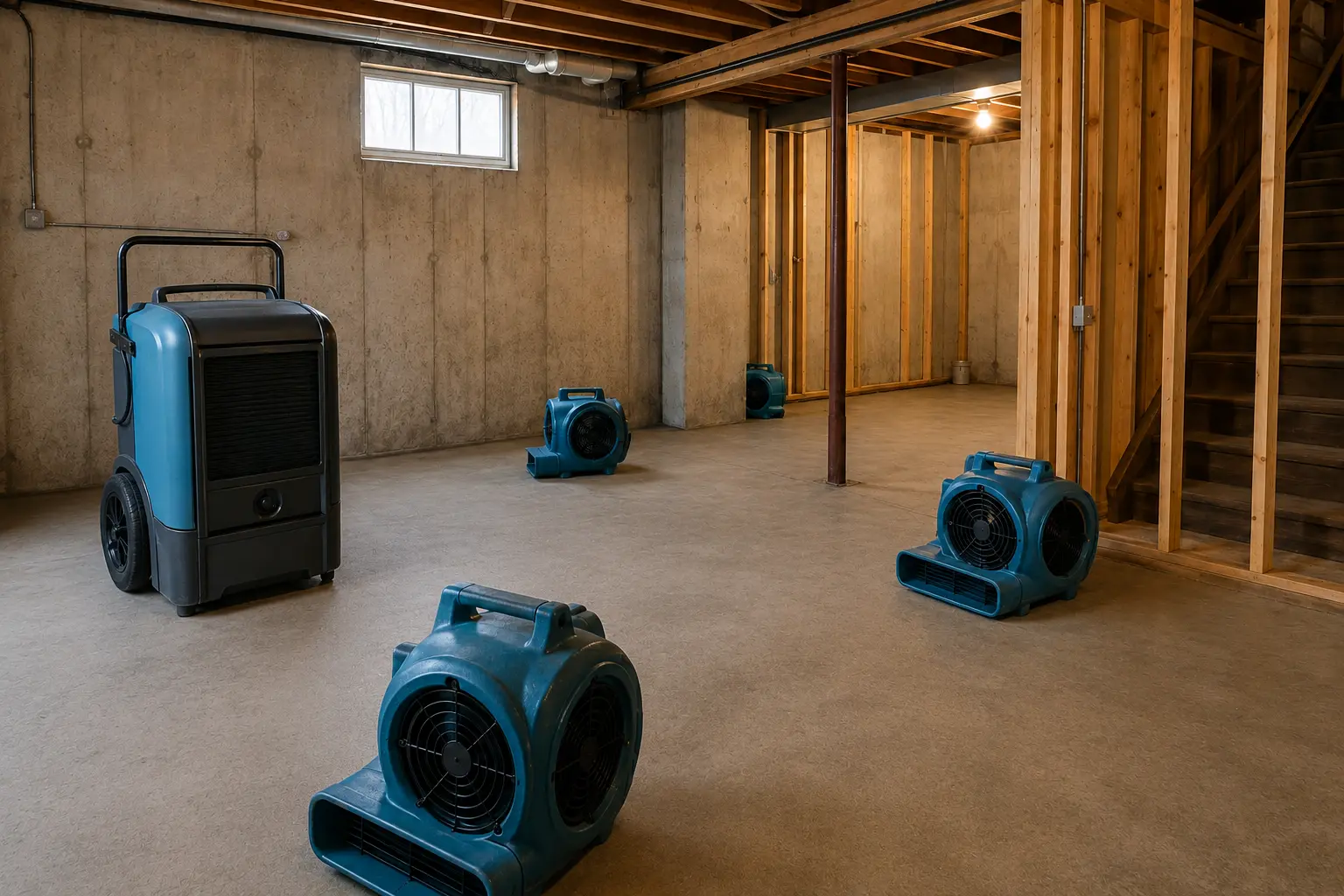
Class describes the evaporation load: the proportion of the affected area's surfaces and materials that took on water, and how readily those materials release it. A small area with a little wet carpet is a very different drying problem from a whole floor where the water reached walls, insulation and subfloor.
The higher classes are defined by two things: the amount of wet material relative to the space, and the presence of low-evaporation materials that hold water and release it slowly.
Start the restoration request
Need restoration service for this property?
Send the address, callback number and a short description of the damage. You do not need to diagnose the problem before requesting help.
Why low-evaporation materials change everything
Plaster, hardwood, concrete, masonry, and multiple layers of flooring built up over decades all hold considerably more water than drywall over studs and give it back far more slowly.
A loss involving those materials needs more drying capacity, tighter environmental control and a longer schedule, and it is one of the main reasons an estimate from a national average will not match what a specific building actually needs.
Category and class side by side
The two describe different things. A loss has one of each, and neither predicts the other.
| Category | Class | |
|---|---|---|
| Describes | Contamination in the water | How much material is wet and how slowly it releases |
| Set by | The source and what the water contacted | The affected materials and the proportion wet |
| Decides | What can be dried and kept versus removed | Drying capacity, environmental control and duration |
| Can it change? | Yes: it escalates with time and temperature | Fixed by what got wet, but reassessed as areas open up |
| Example | Sewage backup is category three | A whole floor into plaster and hardwood is a high class |
Why the category escalates and the clock matters
Water degrades. Clean supply water sitting in a warm building among organic materials does not stay clean, and the point at which it is reclassified is a judgement based on the source, the elapsed time and the conditions.
The practical consequence is direct: the same failure found in two hours and found in three days produces two different scopes, and the difference is mostly in what has to be thrown away.
What to ask about your own job
Both should be on the written scope. It is entirely reasonable to ask what category and class the loss was assessed as and what led to each, because between them they explain most of the cost and most of the schedule.
If the scope has neither, that is worth asking about too. They are the two facts every subsequent decision rests on.
Why Vermont buildings skew toward the harder classes
A large share of this region's housing predates the drywall era. Plaster over wood lath in Burlington's Old North End and Hill Section, in Winooski's converted multifamily, in Essex Junction village and in the older village centres of Richmond, Shelburne and Jericho: all of it is low-evaporation material.
Add the region's habit of layering flooring over decades, the board sheathing in the oldest stock, and the masonry and heavy timber in Winooski's converted mill buildings, and a routine loss here is frequently a harder drying problem than the same water volume would be in a newer building.
Finished basements are the other local factor. Across every town in this service area they are where losses land regardless of where they started, and they combine carpet, pad, drywall and a concrete slab that releases water slowly.
Clear answers
Common questions
Does a higher class mean more expensive?
Generally yes, because it means more drying capacity for longer and usually more material affected. It is a description of the drying problem rather than a price band, but the two correlate.
Is flood water always category three?
Water that has been in contact with ground, a river or sewage is handled as grossly contaminated. The assessment is made by the professional inspecting it, based on the source and what it contacted.
Why does my job have so much more equipment than my neighbour's?
Usually class. More wet material, or materials that release water slowly, need more capacity and tighter environmental control for the same amount of visible water.
Authoritative references