The short answer
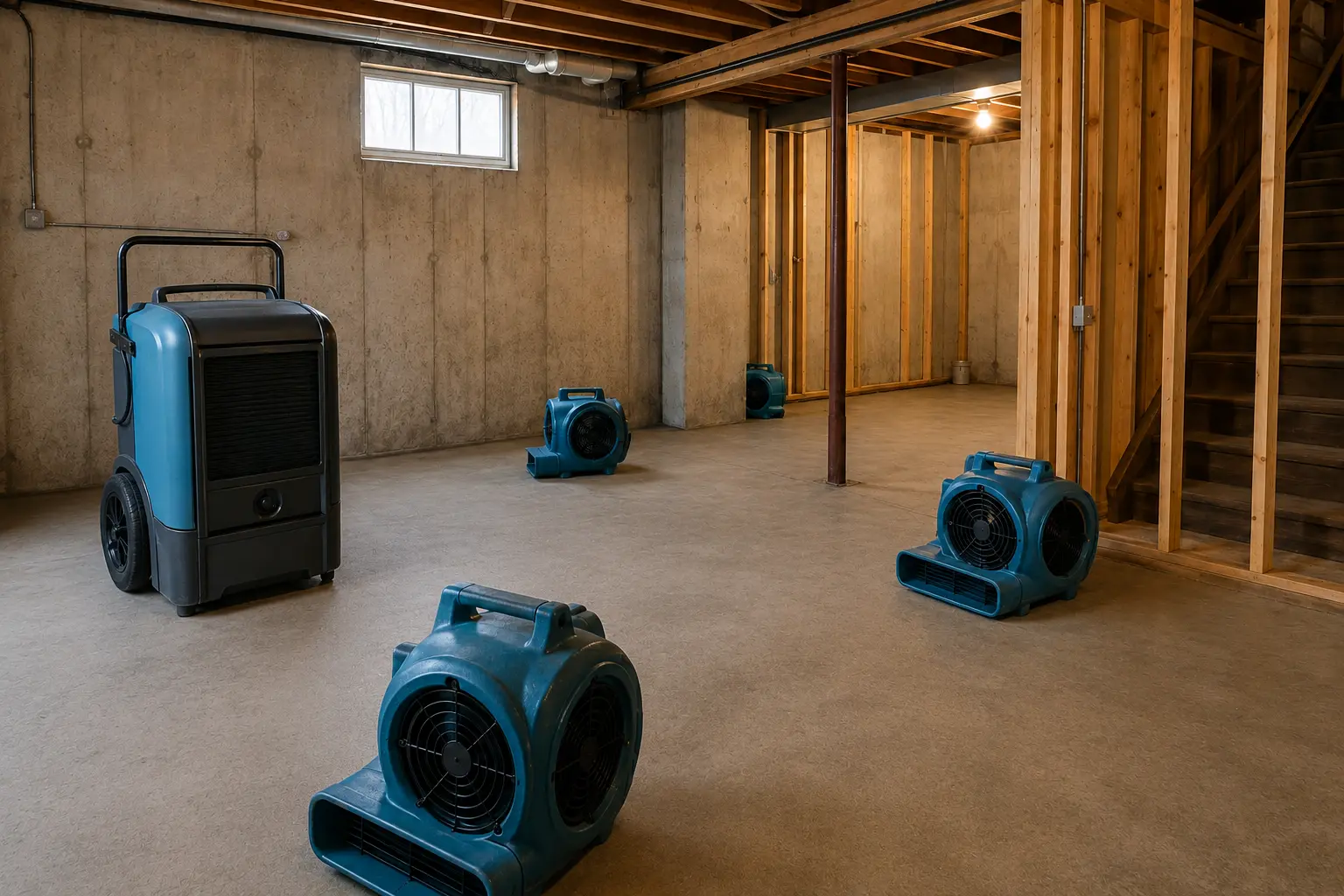
Air movers push air across wet surfaces to speed evaporation, dehumidifiers remove that evaporated moisture from the air so it does not simply resettle, air scrubbers filter particulate where removal work is happening, and containment keeps the treated air in the space that needs it. Air movers without dehumidification just move humid air around; dehumidification without airflow dries the room and not the materials.
Air movers: making evaporation happen
A wet material sits under a thin boundary layer of air that has already absorbed as much moisture as it is going to. Until that layer is disturbed, evaporation slows almost to a stop no matter how dry the rest of the room is.
Air movers exist to break that layer, which is why they are aimed along surfaces at a shallow angle instead of pointed at things. Position and angle do more for a drying job than adding more units does.
Dehumidifiers: taking the moisture out of the loop
Everything an air mover evaporates goes into the room air. Without something removing it, the air reaches equilibrium and the water simply redeposits onto cooler surfaces elsewhere: frequently somewhere that was dry before.
The dehumidifier is what makes the process one-directional. It is also why the affected space is usually closed up instead of ventilated: an open window in humid weather is an unlimited supply of new moisture to remove.
Start the restoration request
Need restoration service for this property?
Send the address, callback number and a short description of the damage. You do not need to diagnose the problem before requesting help.
Containment: deciding where the effort goes
Containment is not only about stopping contamination spreading. It also concentrates the treated, dehumidified air on the affected area instead of conditioning the whole building.
A job with the right equipment and no containment can genuinely dry more slowly than a job with less equipment and a properly sealed work area.
Air scrubbers and negative pressure
Where material is being removed, particularly mold remediation or fire residue work, air filtration units draw air through HEPA filtration and, in mold work, hold the space under negative pressure so air moves into the containment rather than out of it.
That is a containment function instead of a drying one. A drying job may have no air scrubber at all and be perfectly correct.
Why it cannot be switched off at night
Drying stops when the equipment stops, and worse, moisture redistributes back through the materials as the system equilibrates. Several hours off does not pause the job, it partially undoes it.
Noise is a real problem and worth raising, but the answer is placement, containment and scheduling, not switching it off. Say so early instead of turning things off and having the readings stall.
Where the electricity goes
The equipment does consume a noticeable amount of power for the days it runs, and it is normally identified as a line item in the scope. It is a fair thing to ask about before the equipment is placed rather than after the bill arrives.
On larger jobs the load can exceed what a building's existing circuits carry, which is why commercial work frequently includes temporary power as part of the plan instead of as a surprise.
What this means in a Vermont building
Two local conditions change the equipment plan here more than anything else. The first is the region's older stock: plaster over lath, board sheathing and layered flooring in Burlington, Winooski, Essex Junction and the village centres hold considerably more water and release it more slowly than drywall over studs, so the same loss runs longer with more monitoring.
The second is the season. In January, dry outdoor air means ventilation can genuinely help and heating the space assists evaporation. In July and August, when dew points in this region are at their highest, opening a window into a cool basement adds more moisture than it removes, which is the single most common well-intentioned mistake people make here.
Lakeside property in Colchester, Shelburne, Charlotte and Burlington holds that humid condition later into autumn than inland property, so the closed-and-dehumidified approach stays correct there for longer than the calendar suggests.
Drying equipment roles
The equipment that arrives on a water loss looks like a lot of noise and cost until you know that each item has a specific job, with air movers speeding evaporation, dehumidifiers taking the moisture back out of the air, scrubbers filtering dust where removal is happening and containment keeping the effort focused where it belongs.
| Equipment | Job | Why it stays on |
|---|---|---|
| Air mover | Speeds evaporation | Keeps air moving across wet surfaces |
| Dehumidifier | Removes moisture from the air | Stops moisture resettling |
| Air scrubber | Filters particulate | Where removal work occurs |
| Containment | Focuses the effort | Keeps the work area separate |
Clear answers
Common questions
Why are the fans pointed at the walls and not at the wet floor?
Air movers work by breaking the saturated boundary layer that sits against a wet surface, which needs air moving along the surface at a shallow angle. Pointing one at something is much less effective than sweeping across it.
Do I need this many machines?
The count is set by the affected volume, the class of loss and the materials involved. It is a reasonable question to ask, and the answer should reference those things instead of being a general assurance.
Should I open the windows to help?
It depends on the weather. In cold, dry conditions ventilation helps. In July and August in this region, warm humid outdoor air entering a cool space adds moisture rather than removing it.
Authoritative references